

AGRICULTURAL AND FARMING DRONES
Increasing crop yield and sustainability with the latest technology
Over many generations, farmers used to “walk the field” in order to scout the crops, to gather data that would help them to predict natural conditions and react to them in the quickest way possible, in order to achieve an efficient agriculture.
Drones have revolutionized agriculture, by allowing farmers to inspect larger areas in much less time and gather types of information that was never before possible. Today, from the comfort of a single take-off zone, farmers can capture data on crop health, projected yields, and potential problems, enabling them to make informed decisions about the correct levels and types of fertilizer or pesticide application.
Crop Inspection
UAVs can carry a powerful combination of video cameras that record in infrared and visible spectrum to create a crop image that cannot be seen by the naked eye. It highlights the differences between healthy and affected plants, allowing farmers to intervene quickly where necessary and reduce the risk of crop failure. Drones can perform a periodic crop check, combining these images in a time-lapse video sequence and highlighting the differences.
Crop Consulting
The days of scouting the fields by foot are over. This traditional method involves intense work, it is time consuming and it can be difficult when crops are dense. Drones provide farmers with larger inspection capabilities to efficiently monitor their crops, by assessing them on a scale, while creating maps that help them better manage their crops and time. By mounting cameras with high-resolution sensors on drones, even plant counting can be done so that more accurate crop estimates can be made.
Irrigation Management
Farms around the world are constantly looking to optimize water consumption. However, too much or too little affects productivity, which means that detailed tracking and monitoring is needed. Once crops, such as corn, begin to reach certain heights, tracking irrigation by conventional methods can be difficult. Drones paired with thermal cameras are ideal in this case, as they are able to detect from above what humans cannot from the ground. Drone images provide farmers with detailed information about pooling or leaks and the condition of the fields, allowing them to use water resources more effectively.
Crop Spraying
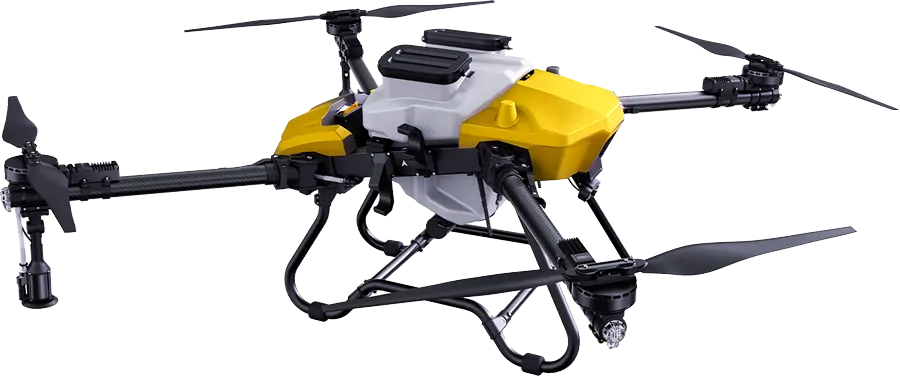
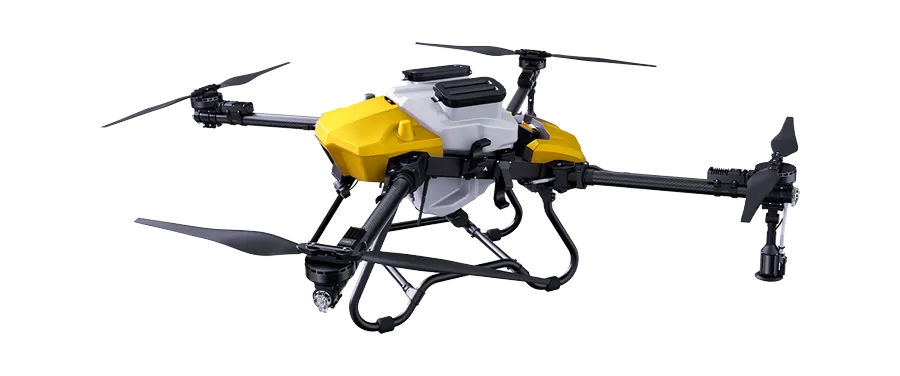
For decades, farmers have relied on either manual spraying or spraying equipment for tractors to cover larger fields. None of these options are ideal, as they are both labour-intensive and they cost a lot. Agricultural drones have the ability to carry a large payload of spray and can be operated more safely at a fraction of the cost compared to crop dusters, and more efficiently than manually spraying from a vehicle. By using drones, modern farms have a new spraying tool that reduces workload and maximizes coverage.
OUR AGRO DRONES
Other Benefits
- Safety

farmers are protected from poisonous substances and sunstroke while spraying liquid pesticides, fertilizers and herbicides on the fields. - High efficiency

an area of 20 to 40 ha of land can be covered in a day, which is 30 times larger than with the use of classic backpack sprayers. - Environmental protection

water and soil pollution is significantly reduced due to the fixed position and orientation method. - Reduction of losses

the use of pesticides is cut by 30% by the high degree of atomization and by spraying substances on the entire height of the plants. - Water saving

up to 90% water saving compared to traditional methods, due to the use of an ultra-low volume spray technology. - Reduced costs
costs are reduced by 97% compared to traditional spraying methods. - Wide range of applications

drones are not influenced by terrain configuration or crop height. They easily manage low-altitude flights and they do not damage plants, being operated by an ergonomic and innovative remote control.
Characteristics
- Efficiency & Effectiveness
The large spray width of our drones covers a larger area with one pass. Pesticides are sprayed on the entire height of the plants, using the air flow generated by the propeller and increasing the efficiency of the nozzles. - Easy to use and transport

ADT drones can be operated easily and efficiently even by a beginner. Our drones have a foldable frame, being easy to pack and transport. - Continuous operation

The 4-arm design allows the ADT drone to operate continuously, while the engines take over the equally distributed load. This avoids engine overheating, eliminating cooling periods and saving substantial time. - Quality control

Before delivery, each drone is 100% tested and must undergo a rigorous quality control to confirm that it meets the highest standards of performance, safety and durability. - Neat design

ADT agricultural drones are based on a special wiring board for the assembly of engines and the ESC system, which allows for a well ordered arrangement of internal cables. - Easy maintenance and repair

ADT drones have an extended life-span and very low maintenance costs due to interchangeable high quality components.
